Urban legends often feel like campfire fabrications designed to make us look over our shoulders in the dark. They are the “friend of a friend” accounts we dismiss as psychological thrillers meant to keep children from wandering into the woods or to stop teenagers from parking in secluded lovers’ lanes. However, every now and then, the boundary line between folklore and reality completely blurs.
Beneath the layers of hyperbole and decades of oral distortion lie terrifying, documented historical truths. From real-life boogeymen to genuine domestic nightmares, here are the disturbing, fully authenticated details behind 10 of the creepiest urban legends that turned out to be completely true.

1. The Corpse Under the Mattress
The Legend: A weary couple checks into a budget motel or a high-end hotel room, looking forward to a restful night. Instead, they are immediately bothered by a thick, nauseating, foul stench that smells strongly of rotting sewage or a backed-up drain. After complaining to management—who dismiss the odor as a minor plumbing issue or fresh paint—the guests try to sleep through the night. The smell becomes so unbearable that they finally take matters into their own hands. They strip the sheets, lift the heavy mattress, or cut open the fabric of the box spring, only to discover the decomposing body of a murder victim hidden directly inside the bed frame.
The Reality: This specific claustrophobic nightmare is one of the most frequently told campfire stories in the world, and it has actually happened multiple times across the United States. Notable recorded instances where guests slept inches away from a corpse occurred in Las Vegas (1977), Atlantic City (1999), and Florida.
The Memphis Case: One of the most chillingly documented real-world examples took place in Memphis, Tennessee, in March 2010. Sony Millbrook, a 28-year-old mother of five, went missing, and her family desperately searched for her. Unbeknownst to them, she had been murdered inside her room at the Budget Inn on Elvis Presley Boulevard. Her killer had stuffed her body deeply into the hollow structural space inside the metal box-spring frame underneath the mattress.
The true horror of the case lies in hotel negligence and sensory adaptation. Hotel staff had actually cleaned the room, changed the sheets, and checked in several different guests over a period of many days. Multiple people slept on that very bed, noticing a strange odor but ignoring it. Finally, a guest grew so overwhelmed by the smell that they looked beneath the mattress and discovered Millbrook’s body. Her boyfriend was later convicted of the murder.

2. The Real-Life “Boogeyman” (Cropsey)
The Legend: Throughout the 1970s and 1980s, children on Staten Island, New York, were terrorized by whispers of “Cropsey”—a classic boogeyman with a sharp hook for a hand who had supposedly escaped from a nearby, shuttered insane asylum. The campfire folklore warned that he lived like a ghost in the decaying, abandoned subterranean tunnels running beneath the local woods, emerging only under the cover of pitch darkness to snatch missing children off the streets and drag them into the shadows.
The Reality: The terrifying truth is that Cropsey was directly inspired by a real-life monster named Andre Rand. Rand was a former employee who worked as an orderly at the Willowbrook State School—a notorious, overcrowded, and deeply abusive state institution for children with intellectual disabilities located on Staten Island. After the horrific conditions of the school were exposed and the facility was ultimately closed, Rand lived as a transient, squatting in makeshift campsites and the sprawling network of tunnels in the surrounding woods. In the late 1980s, the myth collided with reality when Rand was officially arrested, tried, and convicted for the kidnapping and disappearances of young girls in the area. His capture proved to the community that the boogeyman stalking the local woodlands wasn’t a supernatural fabrication, but a terrifyingly real flesh-and-blood predator.
3. The Green Man (Charlie No-Face)
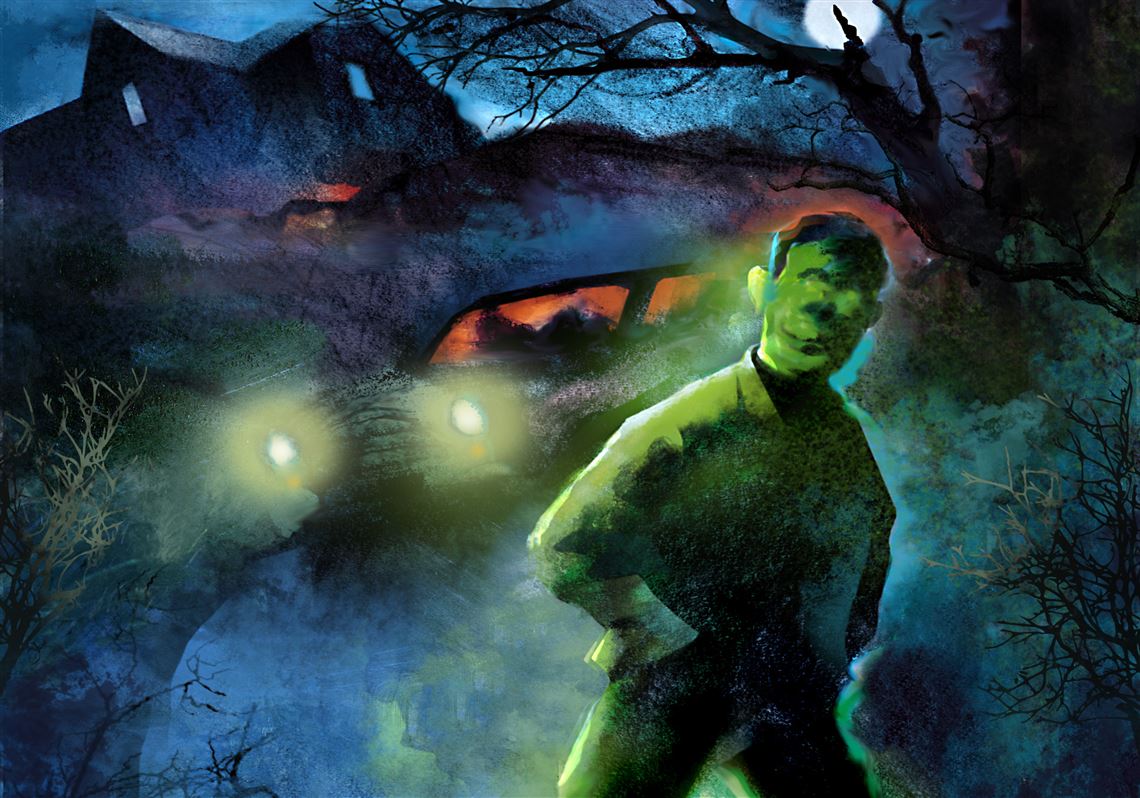
The legend of “The Green Man” is one of the most enduring pieces of folklore in western Pennsylvania, historically passed down among teenagers driving down dark country roads. The story described a glowing, faceless phantom who stalked desolate highways at night, possessing a body so supercharged with residual energy that a single touch of his skin would deliver a fatal electric shock.
While the supernatural elements were entirely fabricated by imaginative locals, the legend itself was rooted in a deeply moving and tragic human reality.
The Reality Behind the Myth
The terrifying “phantom” was actually a remarkably gentle, soft-spoken man named Raymond Robinson (1910–1985).
The Accident
In 1919, when Raymond was just nine years old, he was walking with friends near the Morado Bridge outside Beaver Falls, Pennsylvania. He climbed a trolley line pole to peer into a bird’s nest, unaware that the wire carried a lethal charge of 1,200 to 22,000 volts. The resulting electrical arc caused a catastrophic blast that doctors assumed he wouldn’t survive. Against all medical odds, Raymond lived—but the accident permanently cost him his eyes, his nose, both lips, and his right arm at the elbow.
The Nocturnal Walks
As he grew into adulthood, Raymond became a skilled craftsman, making leather wallets and belts to maintain his independence. However, because his severe facial disfigurements understandably shocked and uncomfortable strangers during the day, he chose to spend his daylight hours inside his family home. To get fresh air and exercise without causing a public scene, Raymond began taking exceptionally long, peaceful walks along a stretch of State Route 351—but only under the absolute cover of total darkness.
How the Legend Evolved
As motorists caught fleeting glimpses of a faceless figure tapping a walking stick along the shoulder of the highway at 2:00 AM, rumors exploded:
The Faceless Feature: Raymond walked with a guide stick and kept his disfigured face uncovered, which passing drivers misinterpreted as a supernatural lack of features.
The Green “Glow”: His skin occasionally took on a ghostly green hue, but this wasn’t due to electricity. It was merely the stark reflection of oncoming car headlights bouncing off his pale skin or the heavy, green woolen winter jackets he frequently wore.
The Fatal Touch: The rumor of a “fatal electric shock” was a natural folklore evolution, dynamically created by teenagers who knew a massive electrical accident had caused his appearance.
A Community’s Hidden Friend
Despite the terrifying stories circulating in nearby schools, the reality of Raymond’s nightly walks eventually became a localized tradition. As the years went on, generations of locals realized the “Green Man” was no monster.
Cruising Route 351 to look for Raymond became a rite of passage, but the fear was replaced by empathy. People would pull over their cars not to flee, but to bring him small comforts. Raymond loved to chat with the teenagers, often posing for photographs or exchanging a few friendly words in exchange for a pocketful of his favorite treats: cigarettes, peppermint patties, and a can of beer.
Though folklore turned him into a boogeyman, Raymond Robinson was ultimately just a resilient man who found a way to reclaim his freedom in the dark.

4. Buried Alive
The Legend: A person falls into a deep coma, suffers a catatonic fit, or is mistakenly pronounced dead by an exhausted town doctor. They are cleaned, dressed in burial clothes, placed into a tightly sealed wooden casket, and lowered six feet underground. Days after the funeral, they suddenly wake up in absolute, freezing pitch darkness, slowly realizing the horrifying reality that they have been buried alive. They scream until their voice gives out and frantically scratch at the heavy lid in a desperate bid for freedom, only for their fingers to bleed as the oxygen supply slowly depletes, leaving them to suffocate in their own grave.
The Reality: During the 18th and 19th centuries, medical science was incredibly primitive by modern standards. Without the aid of electrocardiograms (ECGs) to detect faint electrical activity in the heart or brain scanners to confirm brain death, physicians relied on basic external signs like checking for a pulse or holding a cold mirror to a patient’s mouth to look for condensation. Consequently, individuals suffering from severe cholera, deep catatonic stupors, hypothermia, or comas were occasionally misdiagnosed as deceased and buried while still breathing.
This terrifying risk created a widespread, cultural epidemic of taphephobia—the fear of being buried alive. The panic was so systemic that it gave rise to a highly lucrative market for “safety coffins.” Inventors across Europe and America patented complex grave designs outfitted with air-intake tubes, small viewing windows, and internal ropes tied directly to the corpse’s hands. These ropes led up through the earth to a bell mounted on the surface, allowing a mistakenly buried person to ring for help, which required local graveyards to hire night watchmen strictly to listen for “dead rings.”
The horror was definitively validated during the 1800s and early 1900s when rapidly expanding cities began relocating old, overcrowded inner-city cemeteries to rural areas. Upon exhuming the historical plots, workers routinely uncovered grim, concrete proof of premature burials. Multiple documented accounts from undertakers noted opening old coffins only to find skeletons turned completely face down, interiors deeply gouged with desperate scratch marks, and skeletal fingers worn down to the bone where the victims had tried to tear through the wood.

5. The Funhouse Mummy
The Legend: A local carnival, traveling funhouse, or amusement park features a hyper-realistic, intensely creepy “wax mannequin” or paper-mâché mummy hanging as a prop inside a dark haunted house ride. For years, thousands of oblivious tourists pass by the grotesque decoration, laughing at how convincing it looks. Generations later, a ride maintenance worker or a visiting stage crew accidentally bumps into the figure, snapping an arm completely off the sleeve—only to recoil in absolute horror as a real, splintered human bone and mummified muscle tissue stick out from the broken joint.
The Reality: This stands as one of the most Macabre and well-documented cases in American history where a gruesome campfire story was 100% accurate. In December 1976, a television production crew was setting up to film an episode of The Six Million Dollar Man at the Nu-Pike Amusement Park in Long Beach, California. While prepping the spooky “Laff-in-the-Dark” funhouse ride, a prop master reached out to adjust what they believed to be a cheap, neon-painted papier-mâché dummy hanging from a noose. As they pulled on it, the figure’s arm cleanly snapped off in their hands, revealing unmistakable human bone, marrow, and dried flesh underneath the paint.
A massive forensic and police investigation quickly unraveled a jaw-dropping, decades-long odyssey. The “prop” was actually the preserved corpse of Elmer McCurdy, an incompetent turn-of-the-century outlaw who had been shot and killed by a Western posse following a botched train robbery in Oklahoma in 1911. Because no family members stepped forward to claim his remains, a corrupt local undertaker mummified McCurdy’s body with an aggressive, arsenic-based fluid. He then dressed the corpse up in western attire and charged curious locals a nickel to view “The Bandit Who Wouldn’t Give Up.”
Years later, a pair of traveling carnival promoters masquerading as McCurdy’s long-lost brothers tricked the undertaker and made off with the body. For the next 65 years, Elmer McCurdy’s physical corpse was sold, traded, and passed around the American carnival and sideshow circuit. He was displayed in wax museums, featured as an “authentic opium addict” at movie premieres, and eventually coated in layers of fluorescent paint to hang in the dark corners of amusement park rides. After his accidental discovery in 1976, the traveling outlaw was finally given a permanent, respectful burial, with his casket sealed under two feet of solid concrete at the Summit View Cemetery in Guthrie, Oklahoma, ensuring his body would never be used as a Halloween decoration again.
6. The “Halloween Decoration” Hangman
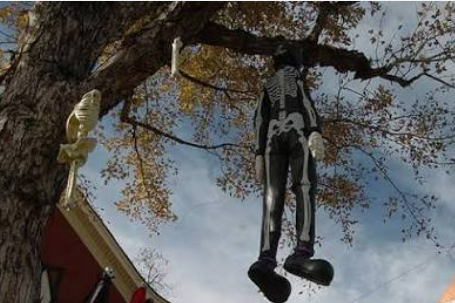
The Legend: Neighbors walking past a suburban home in October admire a highly graphic, incredibly realistic dummy hanging from a tree branch or slouched on a porch chair, assuming the homeowner went all-out on an edgy Halloween display. Day after day, commuters smile at the grim decoration and praise its lifelike detail. It is only days later, when the smell or a lack of movement prompts a closer look, that they discover the horrifying truth: it isn’t a decoration at all, but a real person who committed suicide in plain view, using the holiday’s macabre atmosphere as unintended camouflage.
The Reality: This chilling scenario has tragically manifested into reality on several documented occasions, serving as a grim reminder of how easily context can blind us to horror. The most famous and haunting instance occurred in October 2005 in the small town of Frederica, Delaware. A 42-year-old woman hanged herself from a tree located right alongside a moderately busy road. Because the incident took place just days before Halloween, dozens of neighbors, school children, and passing motorists drove and walked past the body for an entire day. Everyone casually dismissed it as an early, hyper-realistic holiday prank. It took nearly a full day of exposure before a suspicious bystander finally approached the tree closely enough to realize the devastating reality and notify local authorities.
The Psychology of the Blindspot: Psychologists and criminologists refer to this phenomenon as a breakdown in situational awareness. When the human brain encounters something shocking (like a body) within a space where shocking things are actively expected (like a front yard in October), it automatically categorizes the sight as an artificial performance. This exact dark coincidence repeated itself in 2009 in Marina del Rey, California, when a man passed away on his balcony in a slouched position. Neighbors spent days assuming it was a dummy set up for a spooky holiday display before anyone realized they were looking at a real tragedy.

7. The Mad Butcher of Kingsbury Run (The Collector)
The Legend: A ghost-like serial killer stalks the fog-covered alleys of a major city, specifically hunting society’s forgotten souls—transients, vagrants, and the homeless. The killer doesn’t just murder; he possesses a dark, near-supernatural mastery of human anatomy, cutting his victims into clean, surgically precise segments and completely draining them of blood. He then repositions these hollowed-out remains in high-profile public spaces, treating the grisly scenes like a twisted, exhibitionist art display meant to mock the police.
The Reality: During the height of the Great Depression in the mid-1930s, Cleveland, Ohio, became the hunting ground for one of the most elusive and clinical serial killers in American history: The Cleveland Torso Murderer (also known as the Mad Butcher of Kingsbury Run).
The killer explicitly targeted the vulnerable, undocumented transients and drifters who populated “Kingsbury Run”—a desolate, industrial valley of shantytowns and Hoovervilles. The sheer technical precision of the crimes horrified the nation. The Butcher clean-severed the heads and limbs of his victims with a confidence that heavily suggested expert surgical, anatomical, or master-butcher training. In many cases, the victims were decapitated while still alive, and their bodies were entirely drained of blood before being moved.
To make matters worse, the killer was deeply theatrical. He intentionally left torsos and severed heads scattered near police outposts, floating in the Cuyahoga River, or arranged in plain sight to ensure they were found. The terror grew so severe that the city tasked Eliot Ness—the legendary, iron-fisted lawman who had famously brought down Al Capone—with leading the investigation.
Ness was completely outmatched by the phantom. In a desperate, highly controversial move to smoke out the killer, Ness ordered his men to raid Kingsbury Run and burn the entire shantytown to the ground, forcing thousands of homeless residents into the streets. The radical tactic failed. While the murders abruptly stopped shortly after, the Mad Butcher’s identity was never discovered, leaving the case permanently cold and cementing him as a terrifying, real-life boogeyman.
8. The Dog Boy of Arkansas
The Legend: Deep in the rural heart of Arkansas sits a sinister, overgrown house that locals avoid at all costs. According to neighborhood whispers, the property is haunted by the malevolent spirit of a boy who possessed a twisted, sadistic streak. The story goes that throughout his childhood, he would lure stray neighborhood dogs and cat companions onto the property, trapping them in the dark, cramped attic. There, he would perform horrific experiments and torture them in the pitch black. Campfire tales warn that as his cruelty grew, the animals no longer satisfied his urges, and he began hunting human targets, leaving behind a stained legacy that permanently cursed the soil of the estate.
The Reality: This bone-chilling urban legend is not a product of gothic fiction; it is the documented, terrifying historical reality of a home located in Quitman, Arkansas. The real-life boogeyman was a man named Gerald Bettis, who lived in the house during the 1960s and 1970s.
As a child and teenager, Bettis routinely captured stray animals from around the neighborhood and kept them locked inside the home to inflict severe abuse on them. The sheer volume of barking and distressed howling emanating from the property eventually earned him the permanent, infamous local moniker “Dog Boy.”
The horror escalated drastically as Bettis grew into an imposing, massive physical stature, weighing over 300 pounds. His deep-seated cruelty shifted from the local wildlife directly toward his own elderly parents. Bettis subjected his mother and father to years of systemic domestic terror, keeping them virtually imprisoned inside their own home, restricting their movement, and physically assaulting them if they attempted to seek help from the outside world.
Following years of neighborhood suspicion and intervention, Bettis was finally arrested by local authorities for his severe abuses. His reign of terror officially ended when he died behind bars in a state prison in 1988. Today, the Quitman house still stands, frequently cited by paranormal researchers and true-crime historians as one of the most genuinely disturbing locations in the American South—a place where the real-life “Dog Boy” proved that human monsters are far more terrifying than ghosts.

9. Poisoned Halloween Candy
The Legend: A bitter, twisted neighborhood individual spends hours injecting cyanide or embedding hidden razor blades and sewing needles inside miniature chocolate bars and caramel apples. They hand them out to unsuspecting trick-or-treaters on Halloween night out of pure, malicious hatred for children. For decades, this exact urban legend has driven parents to aggressively rip open wrappers, inspect apples, and even demand hospital X-rays of their children’s trick-or-treat hauls before letting them eat a single bite.
The Reality: Decades of extensive sociological and criminological research have largely debunked the myth of a “random, sadistic neighbor” poisoning trick-or-treaters; there is virtually no documented record of a stranger randomly killing a child this way. However, the terrifying campfire story came to life in 1974 through a deeply calculated inside job. Ronald Clark O’Bryan, an optician from Pasadena, Texas, was facing severe financial ruin, drowning in over $100,000 of debt. To solve his financial crisis, he took out massive, secret life insurance policies totaling $60,000 on his own two children. On Halloween night, O’Bryan accompanied his son, daughter, and a few neighborhood children out trick-or-treating.
During the walk, he intentionally stepped away into the darkness, managed to get a hold of five giant Pixy Stix straw candies, and laced the top two inches of the powdered sugar with a lethal dose of potassium cyanide. He then handed them out to the children, claiming a generous, anonymous neighbor down the street had given them to him. Later that evening, he actively encouraged his 8-year-old son, Timothy, to eat the poisoned candy before bed. Timothy tragically died within minutes of consuming the powder.
Investigators quickly noticed massive inconsistencies in O’Bryan’s timeline of events and discovered his mounting debts and the newly minted insurance policies. O’Bryan had attempted to weaponize the pre-existing “poisoned candy” urban legend to execution-style murder his own children, hoping to shift the blame onto a fictional “mad neighbor.” He was caught, convicted of capital murder, and executed by the state of Texas via lethal injection in 1984, forever earning the dark, real-world title of “The Candyman.”

10. The Slender Man Stabbing
The Legend
Deep within the dark, unmoderated corners of internet horror forums, a myth emerged of a towering, faceless entity known as Slender Man. Dressed in a crisp black suit, with unnaturally long, tentacle-like appendages extending from his back, he was said to haunt desolate forests and abandoned suburban playgrounds. The digital folklore claimed that he possessed a form of dark, psychological manipulation, whispering into the minds of vulnerable young children. According to the internet creepypasta lore, he would stalk his targets, slowly driving them to paranoiac madness until they committed acts of horrific, sacrificial violence in his name to prove their loyalty and earn the right to become his “proxies.”
The Reality
In May 2014, this purely fictional internet urban legend directly triggered a real-world tragedy in Waukesha, Wisconsin. Two 12-year-old girls, Anissa Weier and Morgan Geyser, became deeply, delusionally obsessed with the creepypasta stories surrounding Slender Man. Over several months, the boundaries between digital fiction and reality collapsed for the preteens; they convinced themselves that the entity was entirely real, that they could visit his hidden mansion in the Nicolet National Forest, and—most terrifyingly—that he would brutally murder their families if they failed to show absolute submission.
Believing they had no choice but to act, they formulated a meticulous plan to sacrifice someone to appease the monster. During what was supposed to be a routine birthday sleepover, they lured their 12-year-old classmate, Payton “Bella” Leutner, into a local wooded park under the guise of playing hide-and-seek. Once isolated in the trees, the girls attacked Leutner, stabbing her 19 times with a kitchen knife before abandoning her in the brush.
Miraculously, Leutner survived. Despite her severe wounds, she managed to crawl her way out of the woods onto a nearby sidewalk, where a passing cyclist discovered her and called emergency services. The two attackers were apprehended by police later that day wandering down a highway, still fully believing they were on a trek to find Slender Man’s estate. The case shocked the world, serving as a dark, cautionary milestone of how modern digital folklore and collective internet obsession can manifest into tangible, devastating violence.