1. Ameca (Engineered Arts)
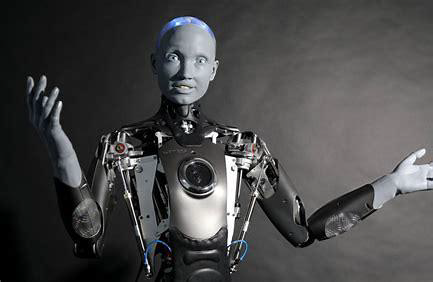
The Hardware & Skin Architecture: Ameca features a high-grade mechanical endoskeleton paired with a specialized grey synthetic elastomer skin. It intentionally avoids human pigmentation to steer clear of the “uncanny valley.” The face is packed with over 30 direct-drive micro-actuators responsible for reproducing asymmetric human micro-expressions, including sneering, squinting, blinking, and jaw alignment during speech.
Computing & AI Integration: Ameca operates as an open-source AI development platform. For human interaction, it processes visual data from high-definition binocular eye cameras and a wide-angle chest sensor. This feeds into real-time facial tracking and sentiment analysis models, allowing it to maintain direct eye contact with whoever is speaking. In 2026, its voice and conversational layer are powered by a customized, low-latency deployment of OpenAI’s GPT-4o, giving it the ability to joke, read room emotion, and adapt its tone instantly.
Operational Footprint: Currently deployed as a high-tier interactive ambassador in global institutions like Dubai’s Museum of the Future and the European Space Agency (ESA).
2. Figure 03 (Figure AI)
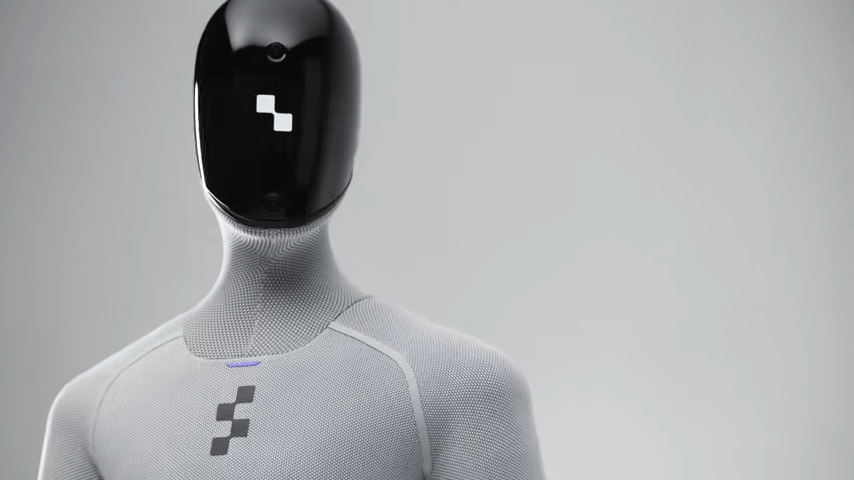
The Hardware & Skin Architecture: Re-engineered from the ground up to move beyond the experimental phase, Figure 03 stands 5’8″ tall and weighs a lightened 60 kg. It abandons bare metal for a sleek, soft-goods textile covering and multi-density foam padding to protect human coworkers from pinch points. Its standout feature is its 22-Degree-of-Freedom (DoF) hands fitted with proprietary tactile sensors capable of registering shifts in pressure down to a minute 3 grams, letting it feel if an object is slipping before it drops it.
Computing & AI Integration: Driven entirely by Figure’s proprietary Helix 02 Vision-Language-Action (VLA) model. Helix 02 processes visual feeds from a 6-camera vision suite (offering a 60% wider field of view than Figure 02) and pairs it with real-time audio. Because the VLA runs completely onboard, Figure 03 reasons out its physical movements and manual tasks locally without relying on cloud inference. It learns tasks through observational imitation learning (e.g., mastering towel-folding by digesting hours of human video).
Operational Footprint: Equipped with 2 kW wireless inductive charging pads inside its feet, Figure 03 walks onto floor-mounted chargers to recharge autonomously, running for up to 5 hours continuously in commercial fulfillment pilots.
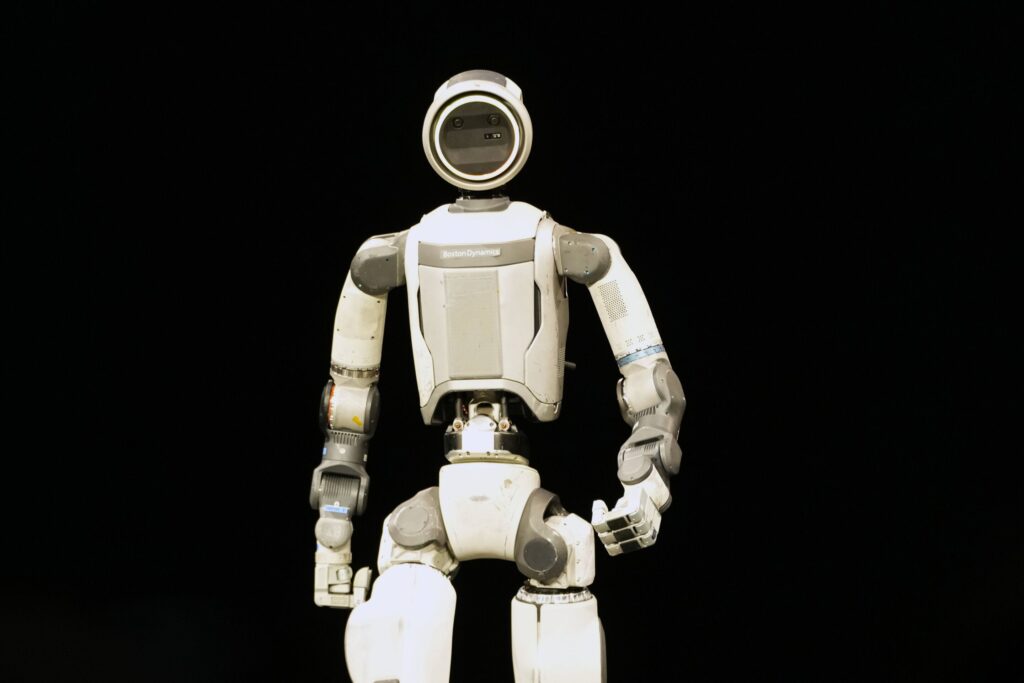
3. Atlas – Electric Production Version (Boston Dynamics)
The Hardware & Skin Architecture: Boston Dynamics has completely retired its famous hydraulic prototype for an all-electric, commercial-production model built with a 3D-printed titanium and aluminum frame. Atlas features 56 degrees of freedom and specialized custom rotational joints. Unlike humans, its neck, torso, and hips can spin a full 360 degrees, allowing it to twist its body into any orientation rather than turning around to change direction.
Computing & AI Integration: Atlas is engineered for pure physical competence. Its perception stack utilizes proprietary machine-learning vision algorithms that map environments via depth sensors and RGB cameras. Through a massive 2026 partnership with Google DeepMind, Atlas integrates cutting-edge physical foundation models, translating high-level spatial data into rapid, predictive balancing adjustments. It features automated battery-swapping capabilities, allowing a fleet manager to run the machines 24/7 without docking downtime.
Operational Footprint: Capable of lifting a massive 50 kg (110 lbs), Atlas is built for industrial settings. Commercial deployments are currently focused on parts sequencing and heavy component handling at Hyundai Motor Group facilities.
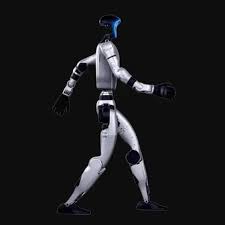
4. G1 (Unitree Robotics)
The Hardware & Skin Architecture: The Unitree G1 represents the push toward ultra-compact, scalable consumer and light-industrial humanoids. Standing at roughly 4’4″ and weighing around 35 kg, its body layout is extremely compressed. It can fold itself into a tight 2-foot bundle for transport and completely unfold itself into a standing position without assistance. It features highly integrated, high-torque joint motors that offer elite physical agility.
Computing & AI Integration: Unitree relies heavily on Deep Reinforcement Learning and advanced simulation training. The G1 can navigate rugged terrain, stairs, and sudden drops because its locomotive brain processes physical feedback hundreds of times per second. If kicked or shoved, its limbs dynamically react to distribute the load and stabilize its center of gravity exactly like a biological entity.
Operational Footprint: Positioned as a mass-production agent, the G1 is widely distributed to academic research labs, light assembly testers, and home automation developers.
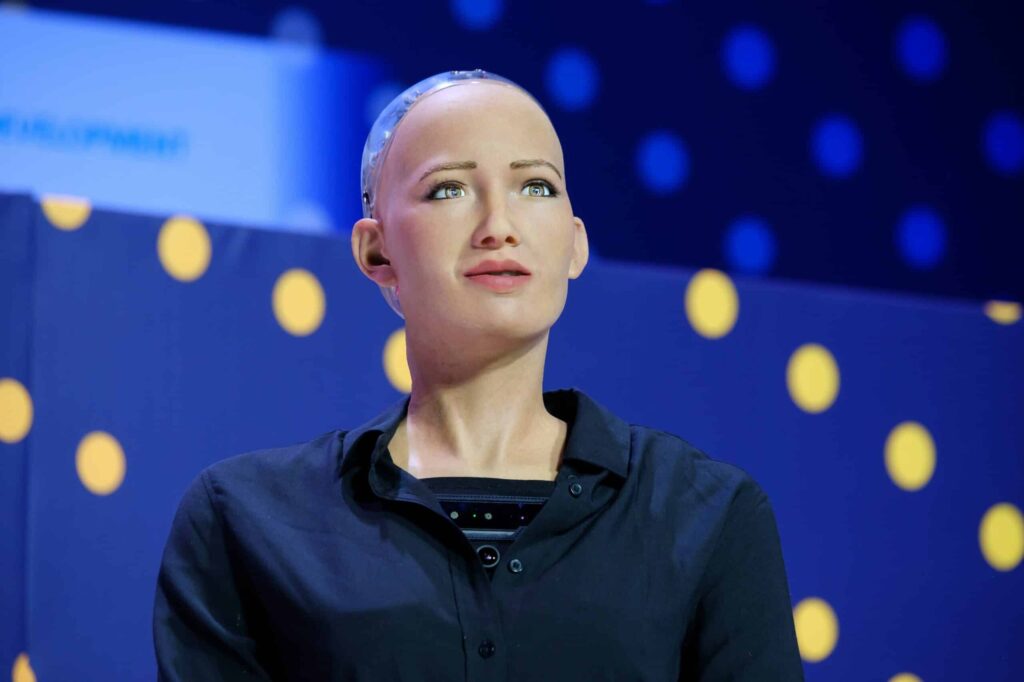
5. Sophia (Hanson Robotics)
The Hardware & Skin Architecture: Sophia remains a foundational icon in social robotics. Her face and neck are mapped in Frubber, a porous silicone matrix that realistically dimples, folds, and moves like human flesh. Underneath the skin layer is an intricate matrix of over 60 mechanical linkages designed to replicate major human facial muscles for natural conversational tracking.
Computing & AI Integration: Sophia utilizes a multi-layered software architecture combining symbolic AI, neural networks, and conversational language models. Using machine perception, she categorizes human expressions and processes speech strings. Her conversational engine allows her to maintain a continuous, persona-driven dialogue, shifting her gaze and micro-expressions to convey a sense of genuine listening.
Operational Footprint: Primarily functions as a global media figure, social interface, and research platform for studying long-term human-robot interaction and emotional bonding.
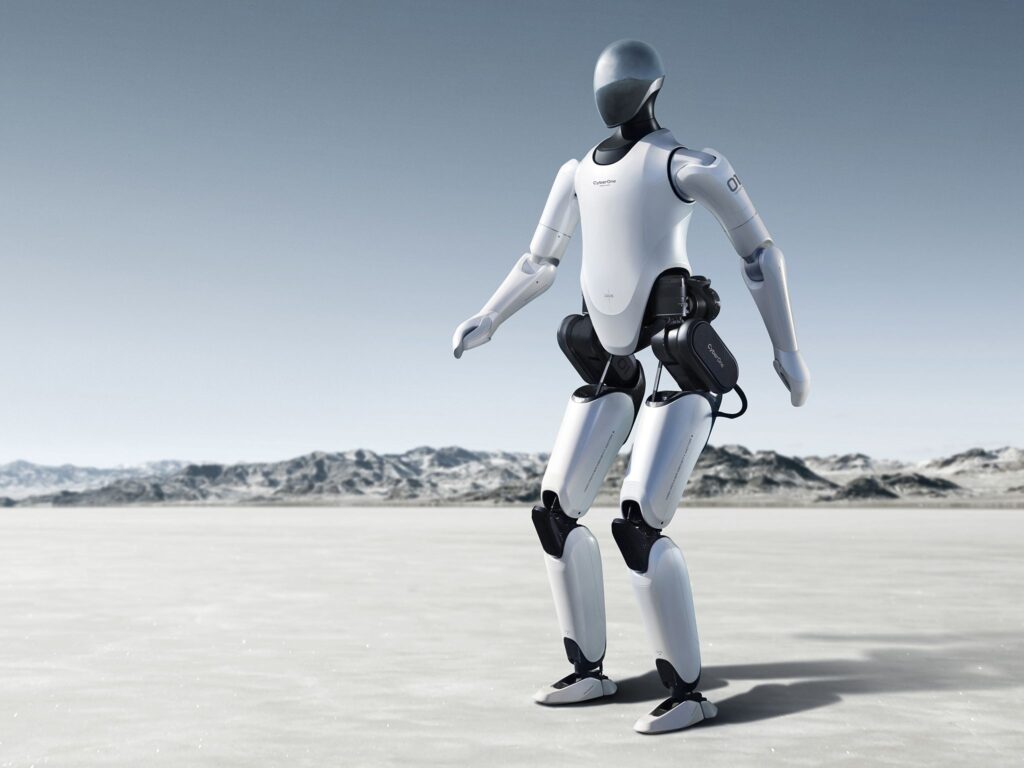
6. CyberOne (Xiaomi)
The Hardware & Skin Architecture: Standing at a human-equivalent 5’10” and weighing 52 kg, CyberOne features a minimalist, curved polycarbonate shell exterior. It uses custom-designed high-efficiency baseline motors, with a peak hip joint torque of up to 300 Nm to ensure steady, upright human bipedal posture.
Computing & AI Integration: CyberOne’s primary engine is focused on spatial and emotional intelligence. It runs an AI Environment Semantics Identification Engine alongside a Vocal Emotion Identification Engine. This combination enables the robot to decode 85 distinct environmental background sounds and isolate human vocal frequencies to detect 45 separate psychological states (e.g., joy, anger, sorrow, anxiety), showing comforting gestures based on your mood.
Operational Footprint: Functions as a flagship research project exploring how humanoid electronics can act as assistive companions within smart home ecosystems.
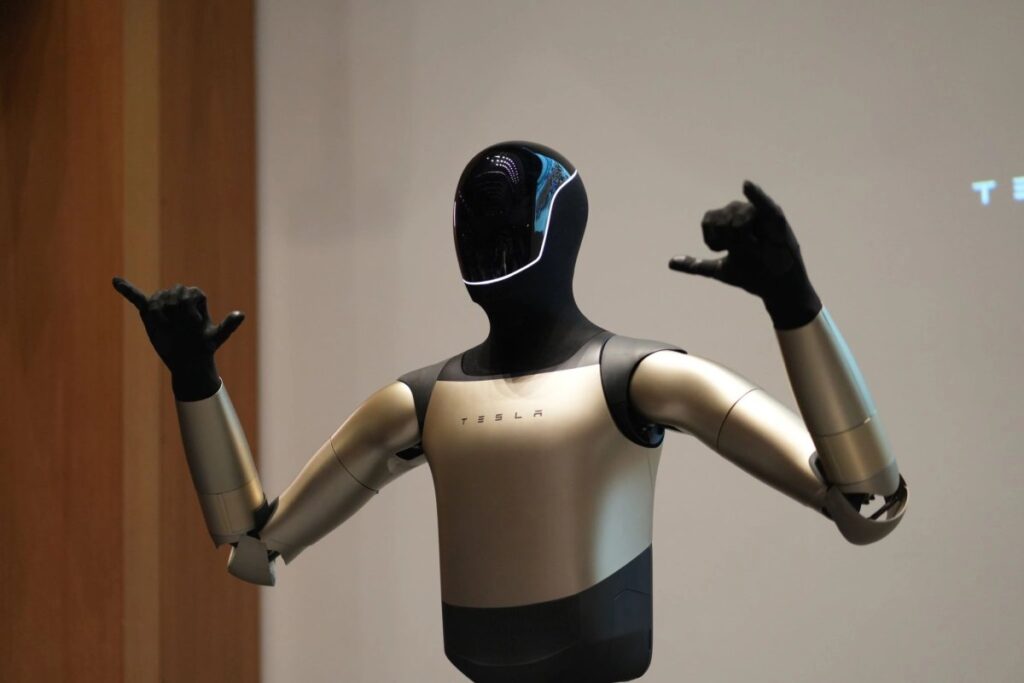
7. Optimus Gen 3 (Tesla)
The Hardware & Skin Architecture: Tesla’s 2026 production-intent humanoid features a 5’8″ frame weighing 57 kg. While keeping its sleek metallic Gen 2 body casing, the crucial breakthrough is its Gen 3 hand architecture. Tesla doubled hand dexterity to 22 degrees of freedom by packaging 25 custom electromechanical actuators into each forearm and hand assembly, mapping natural human finger placement.
Computing & AI Integration: Optimus bypasses traditional robotics software entirely, operating on Tesla’s new AI5 computing chip. It runs the exact same vision-based, end-to-end deep neural networks used in Tesla’s Full Self-Driving vehicles. The AI5 chip delivers 5× the memory bandwidth of older hardware, processing multi-camera spatial data and high-frequency fingertip force-torque feedback simultaneously. This allows the robot to handle fragile objects—like sorting lithium battery cells or moving eggs—entirely through visual and tactile intuition.
Operational Footprint: Hundreds of units are currently deployed in internal testing across Tesla’s Fremont and Gigafactory lines, with mass scaling geared toward a projected 1 million units per year factory run rate.

8. Erica (Hiroshi Ishiguro Laboratories)
The Hardware & Skin Architecture: Erica is an android created to explore the absolute limits of photorealistic human mimicry. Her skin is a custom-colored medical silicone that accurately catches light, matches human skin textures, and hides all underlying mechanics. Her internal structure relies on silent, high-precision pneumatic (air-powered) actuators rather than humming electric motors, eliminating any mechanical sound during operation.
Computing & AI Integration: Erica’s computing architecture centers on conversational presence. While she remains stationary, her system integrates speech synthesis, directional microphones, and infrared depth trackers. Her software coordinates minute physical cues: her chest wall expands and contracts at normal resting breathing rates, her eyelids blink based on natural human rhythms, and her head tilts slightly to indicate focus when a human is speaking.
Operational Footprint: Deployed inside computational linguistics and psychological research labs in Japan, exploring conversational AI, synthetic acting, and human comfort boundaries.

9. Nadine (Nanyang Technological University)
The Hardware & Skin Architecture: Nadine is an identical gynoid clone of her creator, Prof. Nadia Thalmann. Her physical build includes a realistic silicone face and hands, styled hair, and realistic clothing, designed to blend perfectly into standard office or domestic environments.
Computing & AI Integration: Nadine runs a proprietary Social Memory Architecture connected to an intelligent perception framework. When Nadine interacts with a person, she logs their face, voiceprint, and the context of the conversation into a secure database. The next time she encounters that individual—even months later—she recalls past discussions, references personal preferences, and modifies her mood layer based on whether past interactions were friendly or tense.
Operational Footprint: Actively deployed in institutional healthcare pilots and specialized eldercare facilities, assisting with cognitive therapy, social memory games, and daily companionship.
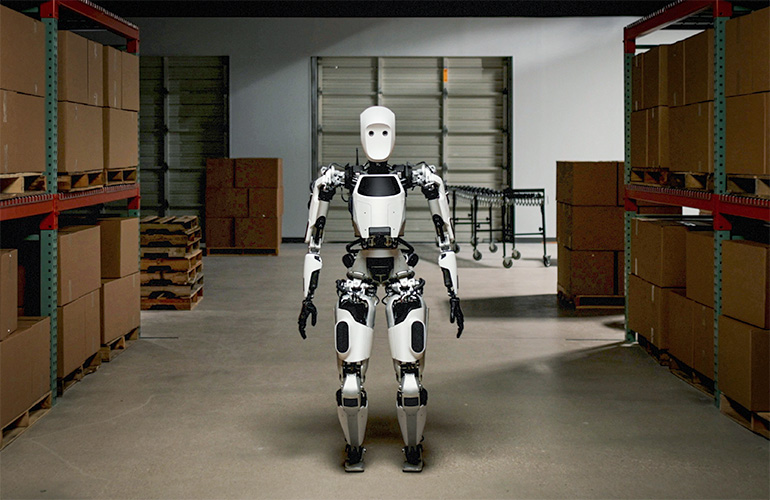
10. Apollo (Apptronik)
The Hardware & Skin Architecture: Apollo is an industrial-strength humanoid standing 5’8″ and weighing 73 kg. It features a heavy-duty, impact-resistant external shell designed for rigorous workplace safety. It moves away from classic complex hydraulic setups, utilizing a highly advanced, field-serviceable linear-actuator architecture across its core joints.
Computing & AI Integration: Apollo uses an open-architecture software environment powered by real-time control algorithms. It tracks spatial changes using a chest-mounted perception suite, allowing it to navigate crowded warehouse floors safely. It communicates its internal operational status, battery levels, and upcoming tasks to human coworkers via a digital face and chest display panel.
Operational Footprint: Built to lift up to 25 kg (55 lbs), Apollo is being integrated into supply chain infrastructures, logistics hubs, and manufacturing facilities to manage repetitive container lifting and trailer loading tasks.